
https://plus.google.com/u/0/photos/105423223007590325423/albums/5813483166205955825/5815696475134012034
Demographics:

Unlike most marine ecosystems, the Hawaiian Marine is regionally located within the Hawaiian Islands. The vast Hawaiian Marine ecosystem surrounds all eight islands of Hawaii which are spread over 1,500 miles in the North Pacific. It extends from the Island of Hawaii at 19◦ N northwest to Kure atoll at 28◦ N. The basaltic waters are home to 5,000 species of invertebrates such as coral reefs and fish as well as 8,000 species of marine algae and plants. The marine region is influenced by equatorial currents and ocean temperatures ranging from 21–29◦ C. Due to its isolation, the biota contains a high percentage ranging from 18–25% of endemic species.

http://www.lonelyplanet.com/maps/north-america/usa/hawaii/map_of_hawaii.jpg
http://www.climatewatch.noaa.gov/wp-content/uploads/2010/01/nwhi-overview-map1.jpg
The following figure represents the Hawaiian Large Marine Ecosystem:

Historical State:
The
Hawaiian Islands are known for its isolation and rich diversity which gave way
to the evolution of thousands of species. Relatively few species were initially
brought to Hawaii through wind, in the ocean, or by birds. With the assistance of
human interaction, even more non-native plant and animal species evolved within
Hawaiian waters. While human interaction brought benefits to the ecosystem, the
Hawaiian Marine has also been damaged as it was overfished, polluted, altered,
and invaded by foreign species. The marine inhabitants have been endangered by
the predation, marine debris, algae overgrowth, and soil runoff. Nearly 85
species of different marine species have gone extinct. Hawaiian sea turtles,
seals, whales, and dolphins are susceptible to endangerment. Measures between 2004 to 2008 show that sea
water has gotten much cloudier and acidic compared to previous states.


http://hawaii.gov/hawaiiaviation/aviation-photos/1910-1919/misc-1910s-photos/1800s%20late%20Outrigger%20Canoes.jpg/image_preview
http://www.aloha-hawaii.com/wp-content/uploads/2010/08/ahihi-kinau-marine-preserve.jpg
http://virtualtourimaging.com/images/underwater.jpg
http://www.bestsingletravel.com/images/Hawaii%20Hanauma%20Bay.jpg
http://www.discoverhawaiitours.com/cms_images/cat_head_snorkel.jpg
Human Impact:
An example of what ship fouling looks like:

http://research.ncl.ac.uk/barnacles/Site/Media_files/Ship%20hull%20fouling.JPG

Human disturbance through urbanization and coastal development has caused changes in water temperatures, flow velocities, and water depth. These stream diversions also rerouted dispersal of migration of fish and other marine species. They can cause further reduction in native populations through competition, predation, and the introduction of parasites or diseases. Fisheries have also greatly contributed to the reduction of many predatory species by overfishing and the release of chemical contamination into the atmosphere, leaving trace of several metals. Human threats including underwater research has also increased ultraviolet (UV) radiation, seawater acidification, the number of warm ocean temperature anomalies relevant to disease outbreaks and coral bleaching, and sea level rise. Oil and waste pollution has also been proven hazardous to the underwater inhabitants.

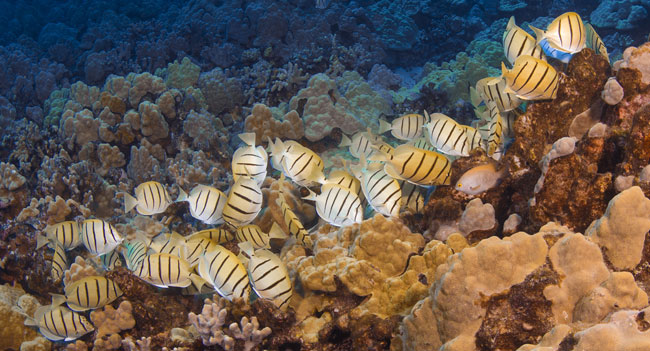 |
| Hawaiian Fisheries |
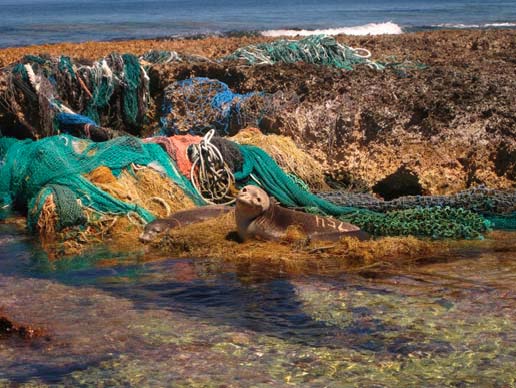 |
| Pollution of Fisheries |
 |
| Water depth and velocity variation |
http://discoverhawaiitours.com/blog/wp-content/uploads/2011/06/shutterstock_48781271.jpg
http://www.monachus-guardian.org/wordpress/wp-content/uploads/2010/11/Two-Hawaiian-monk-seals-in-danger-of-entanglement-as-they-rest-on-a-pile-of-derelict-fishing-gear.-John-Klavitter-USFWS.jpg
http://graphics8.nytimes.com/images/2012/03/23/business/fishing/fishing-blog480.jpg
Benefits from the Ecosystem:
 People are able to gain economic and enjoyment benefits from the Hawaiian Marine ecosystem. With fisheries, they are able to capture a large amount of food source which can be sold for profit. People also utilize the ecosystem for recreational activities such as underwater swimming and snorkeling and above water surfing and boating.
http://www.ahawaii.com/ocean/fairsnub.jpg
Protected Area:
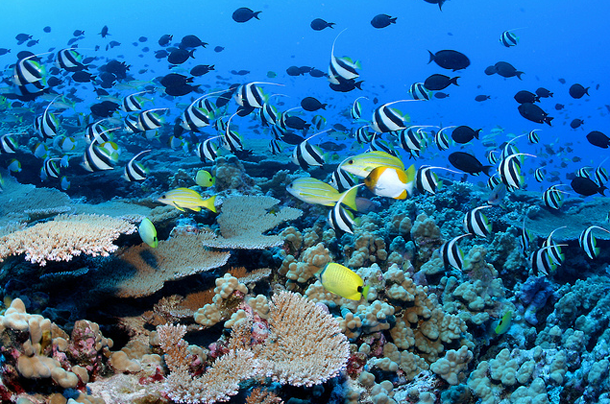 |
| Hawaiian Marine Reserve |
Status:
In regards to the areas which are protected from fishing, the status of the Hawaiian Marine is relatively good. Locations with protected status had a greater amount of variation in species richness, biomass, and diversity than non-protected areas. There was a greater abundance of species in the protected areas while the non-protected areas were specifically altered to have only a few types of species of fish. Surprisingly, the number of fish did not vary significantly between protected and non-protected areas.
Although the status of the protected areas of the Hawaiian Marine may be good overall, the entire ecosystem as a whole is still very susceptible to damage. The end result is that there is overfishing in other areas where there is no protection, thus the biomass in protected areas are “more than 2.5 times greater than partially protected and open access sites”. (Friedlander et al)
Future of the Hawaiian Marine:
The future of the Hawaiian Marine seems to be a bright one. Apart from the debris and ocean plastic scattered in few areas, the ecosystem as a whole seems to have the potential to improve as there are already many ongoing projects and programs to better the Hawaiian Marine. One project is the Hawaii Coastal Use Mapping Project.
The Hawaii Coastal Use Mapping Project is an innovative partnership between NOAA’s (National Oceanic and Atmospheric Administration) National Marine Protected Areas Center. It strives to enhance ocean management by collecting geological data on human impact of the nearshore ocean environment in the Kawaihae-Keahole region. Through illustrating patterns and qualitative information, it provides a very useful image of human uses for the sake of equitable ocean governance. It is helpful to those in charge of resource management and protection. Hawaii has also developed a system of 11 Marine Life Conservation Districts over the past few decades, to conserve and replenish marine resources within the state.
However, global warming and coral bleaching are susceptible aspects in which the ecosystem is changing in temperature and wave currents as well as increasing in sea level and pH level.
Many communities all throughout Hawaii are also currently encouraging community-based management of subsistence fishing areas since 1994, and community-managed areas are still being established today. Only a few locations, such as the Ahihi-Kinau location, are now a harvesting area where the communities teach its children and people how to fish for cultural and educational purposes. If these attempts to reform and improve the conditions of the Hawaiian Marine continue, there is hope for the future of this ecosystem.
What can be done to maintain balance between people and the ecosystem?
In addition to the continuation of these many attempts to reshape the Hawaiian Marine, there are other ways in which we can help maintain the balance between the ecosystem and its people:
- Take part in the ocean governance projects and programs such as those previously mentioned
- Be intentional with fishing methods by using sustainable ones (i.e. Hook and Line, Purse Seine Nets Method, etc.)
- Don’t overfish
- Have a weekly or a monthly debris and ocean plastic clean up
- Recycle to reduce the amount of waste and debris which falls into the oceans
- Educate community about how to fish with sustainable purposes for the ecosystem.
Improving the Hawaiian Marine
As
well as maintaining the balance between humans and the ecosystem, we can take
additional measures in improving our human impacts on the ecosystem. We can
assist in the governmental projects, reduce our use of chemicals and harmful
substances, restrict human activity and fisheries. Through clean up and
restoration of the ecosystem, we can maintain the water variation and quality
closer to its original state. We must be mindful of the needs of the ecosystem
and its marine inhabitants.
Current Impacts:
The following tables depict the current human impacts on the Hawaiian Marine Ecosystem
 |
| Increase in pH level from 2004-2008 |
 |
| Impact organized by areas |
http://hahana.soest.hawaii.edu/hot/methods/fig19.gif
https://docs.google.com/viewer?a=v&pid=gmail&attid=0.1&thid=13b45354409276e9&mt=application/vnd.openxmlformats-officedocument.wordprocessingml.document&url=https://mail.google.com/mail/u/0/?ui%3D2%26ik%3Dd6313577d0%26view%3Datt%26th%3D13b45354409276e9%26attid%3D0.1%26disp%3Dsafe%26realattid%3Df_ha1xrpkj0%26zw&sig=AHIEtbQQ0zeUb-FLXnQEzUmmsR-czN3caA
http://link.springer.com/article/10.1007%2Fs00338-003-0317-2
Why the Hawaiian Marine ecosystem?
We chose to conduct our study on the Hawaiian Marine ecosystem because we have both never been to Hawaii. As a part of our country, we felt that the Hawaiian Marines were the most interesting ecosystem which contained a variety and diversity of marine plant and animal species. Also, during Professor Gillespie’s video of the “World’s Most Endangered Forests,” we were inspired to further our research of Hawaii’s endangerment in the marine habitat and to find ways in which we could protect the ecosystem from further destruction.
References:
